
Cork Fabric: Eco Wonder… or really not?
Why Backing Materials Matter More Than You Think
Cork has earned its reputation as one of the most sustainable materials on the planet. It’s naturally renewable, carbon‑negative, biodegradable, and harvested without harming the tree. On paper, cork fabric looks like the perfect choice for eco‑friendly fashion, accessories, and craft projects.
But here’s the uncomfortable truth: Most cork fabric on the market isn’t actually eco‑friendly.
And the reason has nothing to do with the cork itself — it’s the backing.
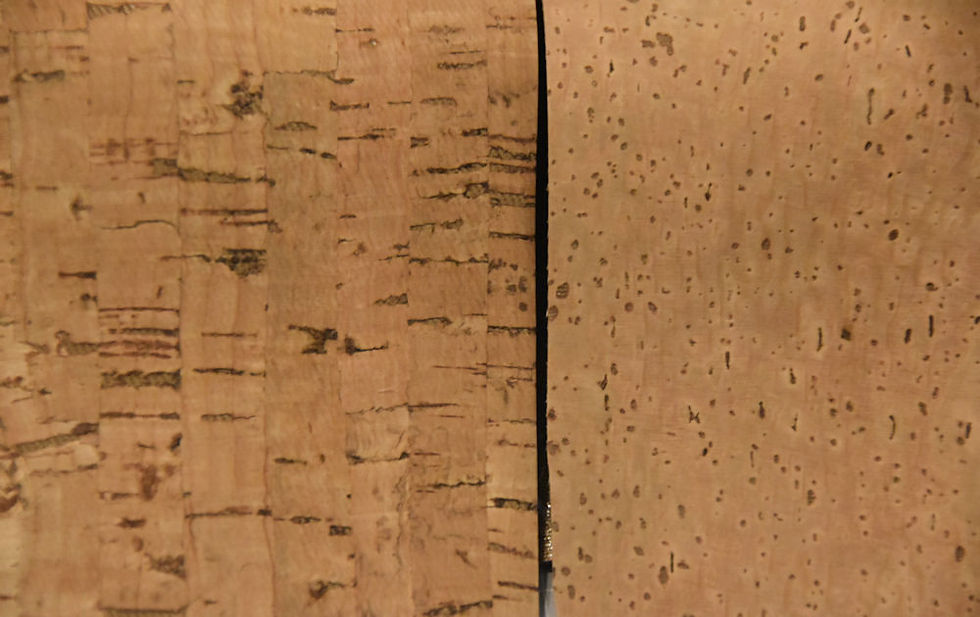
🌱 Cork Is Green. The Backing Often Isn’t.
Raw cork sheets are have great wear resistance, but as a material are too fragile to use alone, so manufacturers bond them to a backing material. In mainstream cork fabric, that backing is almost always polyurethane (PU) — a plastic derived from fossil fuels.
PU-backed cork:
Isn’t biodegradable
Releases microplastics
Has a high carbon footprint
Cracks and flakes over time
Undermines the entire “eco” claim
So while the cork layer is planet‑positive, the backing turns the final product into yet another synthetic textile.
🌿 The Truly Eco Options: Hemp, Cotton, Organic Cotton
A small number of suppliers offer cork fabric backed with:
Hemp
Cotton
Organic cotton
These natural fibres make the entire material biodegradable, breathable, and genuinely sustainable. They also feel better, last longer, and avoid the plasticky stiffness of PU-backed cork.
But there’s a catch.
💸 Why Eco Cork Costs Double (or More)
Natural fibre backing is significantly more expensive to source and process. Hemp especially has higher production costs, and organic cotton requires certification, ethical farming, and slower manufacturing cycles.
So eco-backed cork fabric often costs 2–3× more than the PU-backed versions.
This price difference is exactly where the industry’s biggest problem begins.
⚠️ Greenwashing: When “Cotton Backed” Isn’t Actually Cotton
Some companies advertise their cork fabric as “cotton backed” or “natural fibre backed” — but when you inspect it, it’s actually:
A cotton/polyester blend
A thin cotton layer glued onto PU
A PU backing dyed to look like cotton
Or simply PU, with no cotton at all
Why do they do this?
Because most customers don’t know how to tell the difference. And because the profit margin is enormous.
💰 The Profit Motive Behind Fake Eco Cork
Here’s the business model many suppliers quietly rely on:
Buy cheap PU-backed cork
Market it as cotton-backed
Charge eco-friendly prices
Pocket the difference
If someone complains, issue a refund
No harm done — to them. But plenty of harm done to the planet, and to customers who think they’re making sustainable choices.
This is classic greenwashing: Make it look eco, sell it as eco, but don’t actually make it eco.
And because only a small percentage of buyers know how to test the backing, companies get away with it.
🔍 Why Consumers Rarely Notice
Most people buying cork fabric:
Don’t know what hemp backing looks like
Don’t realise cotton/poly blends aren’t biodegradable
Assume “cork = eco”
Trust the product description
Don’t inspect the underside closely
Don’t know how PU feels compared to cotton
This lack of awareness creates the perfect environment for dishonest suppliers.
🌍 The Real Cost: Sustainability as a Marketing Gimmick
When companies mislabel PU-backed cork as cotton-backed, they’re not just misleading customers — they’re actively undermining the sustainability movement.
They’re:
Flooding the market with fake eco products
Making genuine eco suppliers look overpriced
Discouraging consumers who want to buy responsibly
Turning sustainability into a sales tactic instead of a value
And all of it is done for one reason: profit.
Not planet. Not ethics. Not environmental responsibility.
Just profit.
🧭 How to Tell If Your Cork Fabric Is Truly Eco
A few quick checks can reveal the truth:
Feel the backing — cotton and hemp are soft, matte, and fibrous; PU is smooth and plasticky.
Look for weave — natural fibres have visible threads; PU does not.
Check burn tests (if safe to do) — cotton chars, PU melts.
Ask for certification — organic cotton and hemp suppliers can prove it.
Check the price — if it’s cheap, it’s almost certainly PU.
Real eco cork is never bargain‑bin material.
🌱 Final Thought: Eco Should Mean Eco
Cork fabric can be one of the most sustainable materials available — but only when the backing matches the ethics of the cork itself.
If companies want to sell eco products, they should make eco products. Not plastic disguised as sustainability.
Consumers deserve honesty. The planet deserves better. And the industry needs to stop hiding behind the word “eco” while quietly cutting corners.
Me? "Most" of my products are cork backed with Hemp, or Organic Cotton... I put planet before profit and the price is higher. A few of items (maybe 5%) have got PU or a blend backing, because ether I can't get non PU backed (cork cord) or I've been sold something that isn't as Eco as I was led to believe. But I'm not going to throw that out... thats even worse for the environment. If it is PU backed... I'll say 👍

Comments